An article about the exhibition I participated in Tokyo, Translation in the Expanded Field: Project Lingxi in Jimbocho, has been published in ARTFORUM.
With the help of Google Translate, I brought over the parts that introduce my work and the workshop I led, translated into English.
"Similarly unwilling to be bound by the "original text" is South Korean artist Leo Je-eon Lee. While studying in the United States, he discovered that the Korean word "말" could be translated into several completely different words in English (such as "horse" and "word"). Faced with this semantic multiplicity, he was not frustrated, but rather found enjoyment in it. Therefore, in his work "Horses Die, Leaving Their Skins; Men Die, Leaving Their Names" (2025), exhibited on the third floor, horses gallop tirelessly between diverse semantic meanings, weaving through phrases of shifting meanings. Perhaps, like the act of "translation," the more one strives for accuracy, the easier it is to get lost among multiple meanings. Beneath the image of galloping horses lies the artist's layered application of materials, which gradually merge and construct with the artist's thought and creation process, becoming the supporting surface yet buried in an invisible space. Lee Je-eon thus transforms his work from a simple two-dimensional image into a three-dimensional structure, endowing it with sculptural qualities."
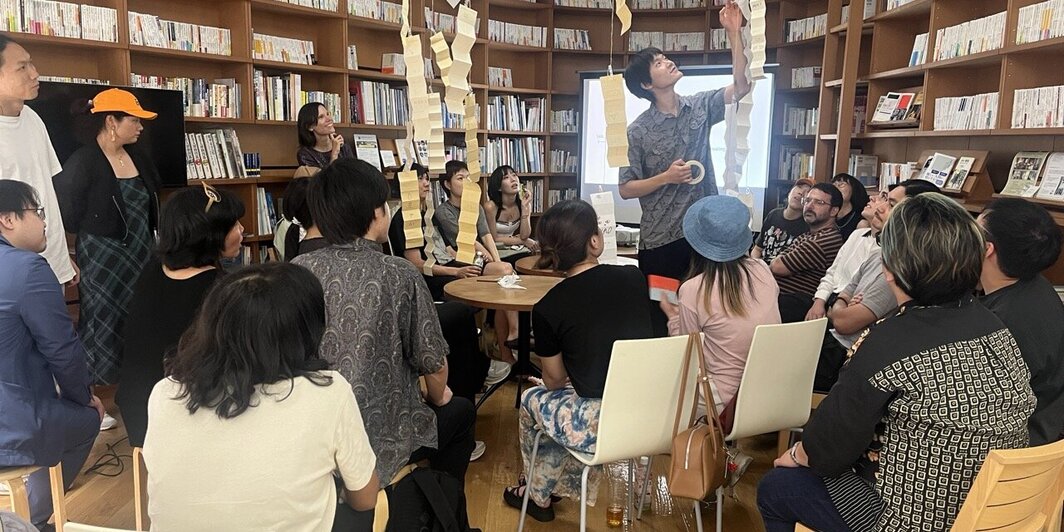
"In the "Lexicon of Stealing" workshop, co-led with anthropologist Špela Drnovšek Zorko, Li Jiyan frankly admitted his "love of random translation" and believed that translation is merely a process of stealing information from the universe, and therefore does not inherently carry the obligation of faithfulness to the original text. In the workshop, he and Špela Drnovšek Zorko had participants each take a long strip of paper, fold it, write a word on the top, and place it anywhere in the room. Others who found the strips could then translate the word in any way they wanted—even if they didn't recognize the language on the strip. Thus, everyone was immersed in this game of "random translation."
Jin Xueni wrote "translation" in English on a slip of paper, followed by the next participant who wrote the Chinese characters for "translation". The third participant, who didn't know Chinese, simply drew a bird and fish skeleton based on the shape of the characters. The fourth participant wrote down the Japanese katakana meaning "bird and fish" based on the drawing. The fifth participant, seemingly unfamiliar with Japanese, wrote "1-11" and a fish image based on the shape of the characters. As more participants joined, the content on the slip of paper gradually evolved: someone drew the Windows system boot screen, which then evolved into the classic Apple logo; finally, the binary code "01010000111..." appeared on the paper. The connotation of translation expanded from human language to the level of human-computer dialogue. Encoding and decoding constantly reversed in the folded space of the slip of paper, and the evolution of the content was like a flash of inspiration, entering a process that was unimaginable beforehand but made perfect sense in retrospect."
An article about the exhibition I participated in Tokyo, Translation in the Expanded Field: Project Lingxi in Jimbocho, has been published in ARTFORUM.
With the help of Google Translate, I brought over the parts that introduce my work and the workshop I led, translated into English.
"Similarly unwilling to be bound by the "original text" is South Korean artist Leo Je-eon Lee. While studying in the United States, he discovered that the Korean word "말" could be translated into several completely different words in English (such as "horse" and "word"). Faced with this semantic multiplicity, he was not frustrated, but rather found enjoyment in it. Therefore, in his work "Horses Die, Leaving Their Skins; Men Die, Leaving Their Names" (2025), exhibited on the third floor, horses gallop tirelessly between diverse semantic meanings, weaving through phrases of shifting meanings. Perhaps, like the act of "translation," the more one strives for accuracy, the easier it is to get lost among multiple meanings. Beneath the image of galloping horses lies the artist's layered application of materials, which gradually merge and construct with the artist's thought and creation process, becoming the supporting surface yet buried in an invisible space. Lee Je-eon thus transforms his work from a simple two-dimensional image into a three-dimensional structure, endowing it with sculptural qualities."
"In the "Lexicon of Stealing" workshop, co-led with anthropologist Špela Drnovšek Zorko, Li Jiyan frankly admitted his "love of random translation" and believed that translation is merely a process of stealing information from the universe, and therefore does not inherently carry the obligation of faithfulness to the original text. In the workshop, he and Špela Drnovšek Zorko had participants each take a long strip of paper, fold it, write a word on the top, and place it anywhere in the room. Others who found the strips could then translate the word in any way they wanted—even if they didn't recognize the language on the strip. Thus, everyone was immersed in this game of "random translation."
Jin Xueni wrote "translation" in English on a slip of paper, followed by the next participant who wrote the Chinese characters for "translation". The third participant, who didn't know Chinese, simply drew a bird and fish skeleton based on the shape of the characters. The fourth participant wrote down the Japanese katakana meaning "bird and fish" based on the drawing. The fifth participant, seemingly unfamiliar with Japanese, wrote "1-11" and a fish image based on the shape of the characters. As more participants joined, the content on the slip of paper gradually evolved: someone drew the Windows system boot screen, which then evolved into the classic Apple logo; finally, the binary code "01010000111..." appeared on the paper. The connotation of translation expanded from human language to the level of human-computer dialogue. Encoding and decoding constantly reversed in the folded space of the slip of paper, and the evolution of the content was like a flash of inspiration, entering a process that was unimaginable beforehand but made perfect sense in retrospect."
-
2025
An article about the exhibition I participated in Tokyo, Translation in the Expanded Field: Project Lingxi in Jimbocho, has been published in ARTFORUM.
With the help of Google Translate, I brought over the parts that introduce my work and the workshop I led, translated into English.
"Similarly unwilling to be bound by the "original text" is South Korean artist Leo Je-eon Lee. While studying in the United States, he discovered that the Korean word "말" could be translated into several completely different words in English (such as "horse" and "word"). Faced with this semantic multiplicity, he was not frustrated, but rather found enjoyment in it. Therefore, in his work "Horses Die, Leaving Their Skins; Men Die, Leaving Their Names" (2025), exhibited on the third floor, horses gallop tirelessly between diverse semantic meanings, weaving through phrases of shifting meanings. Perhaps, like the act of "translation," the more one strives for accuracy, the easier it is to get lost among multiple meanings. Beneath the image of galloping horses lies the artist's layered application of materials, which gradually merge and construct with the artist's thought and creation process, becoming the supporting surface yet buried in an invisible space. Lee Je-eon thus transforms his work from a simple two-dimensional image into a three-dimensional structure, endowing it with sculptural qualities."
"In the "Lexicon of Stealing" workshop, co-led with anthropologist Špela Drnovšek Zorko, Li Jiyan frankly admitted his "love of random translation" and believed that translation is merely a process of stealing information from the universe, and therefore does not inherently carry the obligation of faithfulness to the original text. In the workshop, he and Špela Drnovšek Zorko had participants each take a long strip of paper, fold it, write a word on the top, and place it anywhere in the room. Others who found the strips could then translate the word in any way they wanted—even if they didn't recognize the language on the strip. Thus, everyone was immersed in this game of "random translation."
Jin Xueni wrote "translation" in English on a slip of paper, followed by the next participant who wrote the Chinese characters for "translation". The third participant, who didn't know Chinese, simply drew a bird and fish skeleton based on the shape of the characters. The fourth participant wrote down the Japanese katakana meaning "bird and fish" based on the drawing. The fifth participant, seemingly unfamiliar with Japanese, wrote "1-11" and a fish image based on the shape of the characters. As more participants joined, the content on the slip of paper gradually evolved: someone drew the Windows system boot screen, which then evolved into the classic Apple logo; finally, the binary code "01010000111..." appeared on the paper. The connotation of translation expanded from human language to the level of human-computer dialogue. Encoding and decoding constantly reversed in the folded space of the slip of paper, and the evolution of the content was like a flash of inspiration, entering a process that was unimaginable beforehand but made perfect sense in retrospect."